
Occupancy Classification Sets the Baseline
Managing an industrial facility in Delhi NCR means managing a unique set of risks. From manufacturing plants in Faridabad and Ghaziabad to warehouses in Noida and Gurugram, the density of operations, storage of raw materials, and presence of machinery create a significant fire load. For facility managers and commercial building operators, understanding the fire safety guidelines applicable in Delhi NCR is not just a statutory requirement—it is a fundamental part of operational reliability.
Before planning any protective system, a facility manager must first understand how the building is classified under NBC 2016. Industrial facilities, including factories and processing units, generally fall under Group G. Warehouses and storage sheds fall under Group H. Hazardous process units may fall under Group I. Each classification carries different structural protection requirements, egress configurations, and fire detection duties.
This classification determines the type and extent of fire protection equipment legally required. High-hazard storage areas require greater water flow capacity and robust automatic suppression compared to a light assembly unit. An accurate classification is the first step toward statutory compliance.
Fire Hydrant Norms Under IS 3844
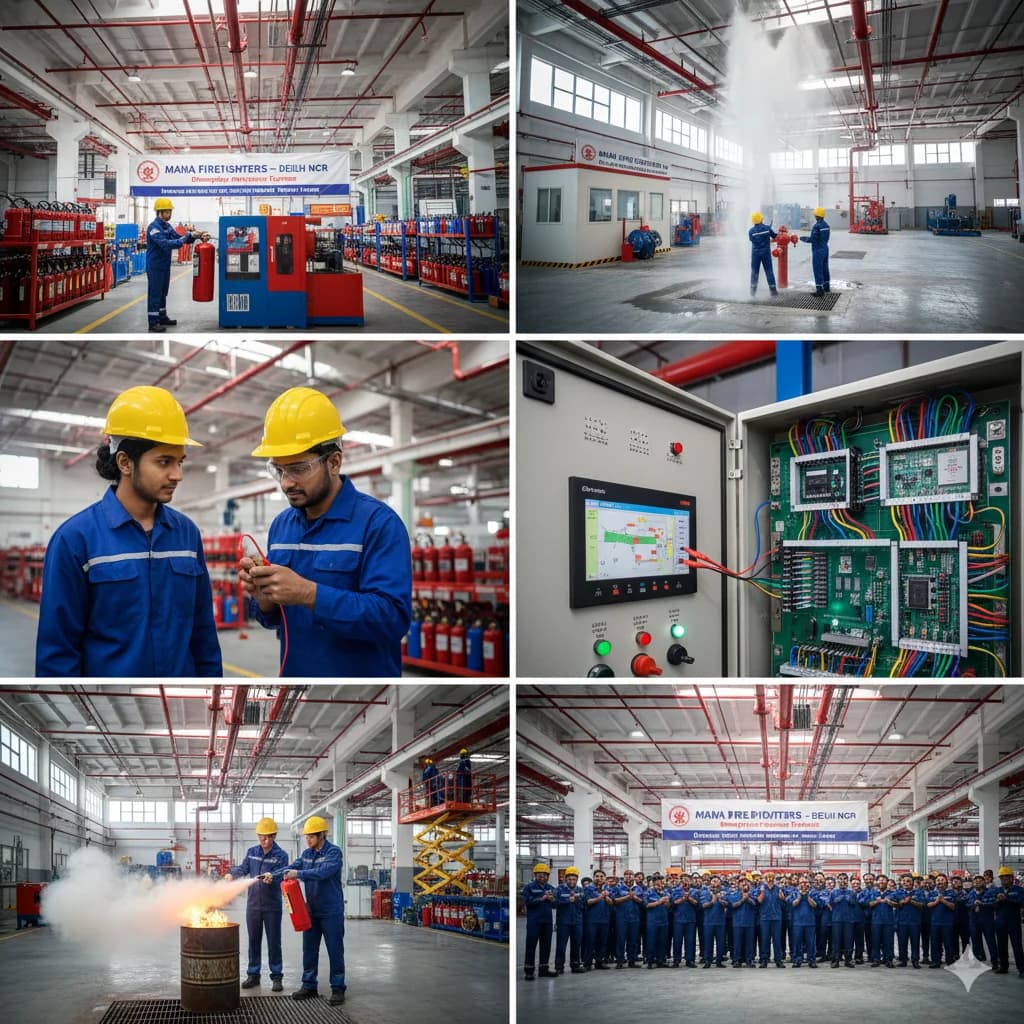
Fire hydrant systems form the backbone of industrial fire protection in large premises. The requirements for such systems are detailed in IS 3844, which governs the installation of internal and external hydrants. For factories and warehouses, internal access, floor areas, and large volumes of water are necessary to deliver effective firefighting response.
According to these fire hydrant norms, every industrial building must typically have a network of hydrant valves, hose reels, and booster pumps connected to a reliable water supply. External yard hydrants are provided around the building perimeter, while internal hydrants are strategically placed within the building to ensure that every area can be reached by a hose stream without excessive travel distance.
What many facility managers overlook is that hydrant systems are not purely passive assets. They require adequate water storage dedicated to firefighting, proper drainage, and careful spacing of hydrant valves. IS 3844 also sets maintenance and testing schedules, including regular checks of pump operation, valve functionality, and pressure levels.
The Role of Automatic Sprinklers and Fire Alarms
Beyond hydrants, an industrial facility in Delhi NCR often needs a combination of automatic fire sprinklers, fire detection and alarm systems, and portable extinguishers. NBC 2016 Part 4 outlines the conditions under which sprinkler systems become mandatory—typically based on building height, occupancy type, and fire load. In warehouses with tall racking and high-value stock, sprinkler protection is essential.
Equally important is timely detection. Industrial settings can be noisy, dusty, and chemically active. Fire alarm and detection systems must be designed to suit those environments, avoiding false alarms while catching actual fires quickly. Heat detectors, smoke detectors, manual call points, and audible/visual alarm devices must match the specific hazard level.
- Automatic sprinklers activate at predetermined heat thresholds (typically 68°C to 79°C) directly above the fire seat.
- Zoned addressable fire alarms pinpoint incidents rapidly, notifying building occupants and automated emergency panels.
- Portable extinguishers (ABC Dry Powder, CO2, Mechanical Foam) placed according to IS 2190 provide immediate first-line control.
Maintenance: The Most Common Compliance Gap
The most frequent gap seen in industrial fire safety across Delhi NCR is not in initial installation, but in ongoing maintenance. NBC 2016 Part 4 clearly states that all fire protection systems must be maintained at all times in serviceable condition. That requires structured periodic testing rather than a one-time setup.
- Monthly visual inspections of hydrants, landing valves, and fire pumps.
- Quarterly testing of alarm systems and standby generator backup power.
- Annual dynamic water flow tests on hydrants to confirm discharge pressure.
- Periodic refilling and hydrostatic pressure-testing of extinguishers.
- Logbook documentation for every inspection and testing cycle.
Turnkey Fire Engineering for Delhi NCR Facilities
The complexity of NBC 2016 Part 4 and IS 3844 makes it difficult for in-house teams to handle everything alone. A turnkey fire protection contractor manages the full lifecycle: conducting risk assessments, preparing hydraulic drawings in line with code, supplying pump-sets, hydrants, sprinklers, alarms, and extinguishers, and completing testing and maintenance.
For industrial facilities across Delhi, Noida, Gurugram, Faridabad, and Ghaziabad, extreme summer heat, high-density industrial corridors, and continuous operations demand genuine operational preparedness. Professional fire protection engineering ensures that statutory compliance and real-world life safety are achieved hand-in-hand.