
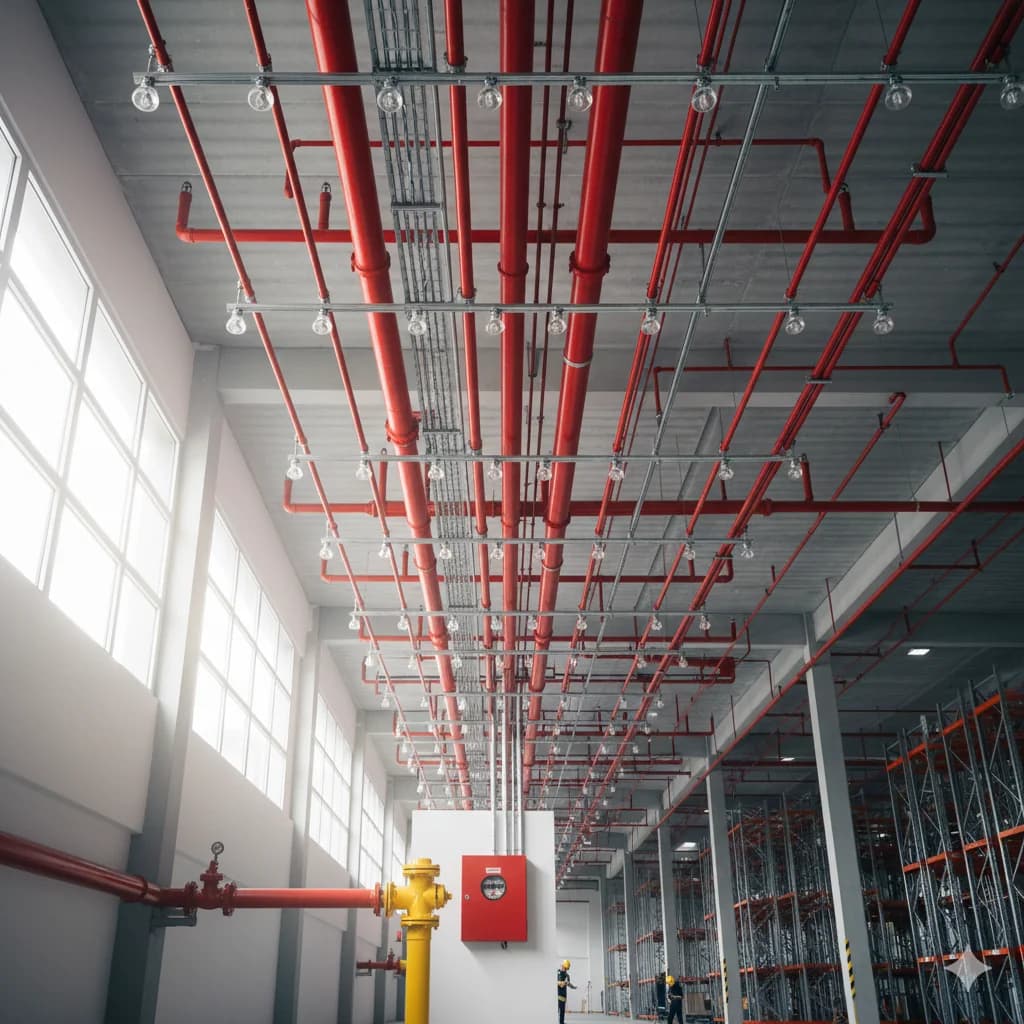
Every industrial outage in Delhi NCR starts with water that won’t flow. A mis‑rated sprinkler head or a hydraulic loop that can’t sustain 2.1 kg/cm² pressure will shut the plant down and stall the NOC renewal.
We’ve watched a steel rolling mill in Okhla lose a week of production because a single quartz‑bulb head was set at 150 kPa instead of the required 200 kPa for high‑response coverage. The fix? Re‑calculate, replace, and test before the next DFS audit.
Why a Wet‑Pipe Fire Sprinkler System Is Non‑Negotiable for Heavy‑Duty Plants
Dry‑pipe or pre‑action systems sound cheaper on paper, but in a 20‑meter‑high storage rack they’re a liability. The code (NBC 2016 Part 4, Section 4.2.3) mandates wet‑pipe for any occupancy where the fire load exceeds 3 MJ/kg. Wet‑pipe delivers instant discharge; there’s no delay for air evacuation.
We specify wet‑pipe for all our industrial projects because the hydraulic calculations are deterministic – you know the flow, you know the pressure loss, and you pass the hydraulic adequacy test on the first try.
Hydraulic Calculation Cornerstone
The rule of thumb we trust on site: minimum 2.5 L/s per sprinkler head at 2.1 kg/cm². For a 30 kW boiler room, that means a 12‑kilolitre reservoir feeding a 0.9‑inch main, with a pressure drop not exceeding 0.4 kg/cm² to the farthest head.
- Determine design density (kg/m²·min) from IS 15105 Table 5.
- Calculate required flow (L/s) using the area of the most demanding hazard zone.
- Select pipe sizes to keep friction loss < 10 % of the design pressure.
Common Mistake: Overlooking the Jockey Pump Set‑Point
Most plant managers think the main diesel‑driven pump does all the work. In reality, the jockey pump maintains system pressure between trips. We’ve seen a Faridabad automotive stamping plant where the jockey set‑point was 0.6 kg/cm² low; the main pump didn’t fire for 12 seconds after a header drop, flooding the floor before activation.
Set the jockey at 0.3 kg/cm² below the design pressure and verify its response time under a simulated drop. The result is a seamless 10‑second recovery that satisfies DFS.
Jockey Pump Acceptance Test
- Pressurize the loop to design pressure (2.1 kg/cm²).
- Open a test valve to drop pressure by 0.5 kg/cm².
- Measure pump start‑up time – must be ≤ 10 seconds.
Rule of thumb: If the jockey pump takes longer than 10 seconds to kick in, the sprinkler system will never meet NBC compliance during a real fire.
Integrating Sprinklers with Addressable Alarm Panels
Skipping the flow switch on the alarm panel is a shortcut that trips every DFS inspector. IS 2189 requires a flow‑activated alarm valve that trips at 0.75 kg/cm² differential. We wire the flow switch directly to the addressable panel so the fire alarm audibly warns the control room before the first droplet hits the ceiling.
Our teams route the low‑voltage cabling through the same conduit as the fire‑hydrant loop, saving space and simplifying future audits.
Audit Checklist – Sprinkler System
- Design density matches IS 15105 Table 5 for the specific occupancy.
- All heads rated for the calculated design pressure; no downgrades.
- Jockey pump set‑point within 0.3 kg/cm² of design pressure; start‑up ≤ 10 seconds.
- Flow switch calibrated at 0.75 kg/cm² and linked to addressable alarm panel.
- Hydraulic test log signed off per NBC Part 4, Section 4.3.2.
Need a hands‑on audit? Our free fire safety audit and cost estimate pinpoints every gap before the DFS visit.
Maintenance Realities – When Theory Meets the Shop Floor
Most facilities schedule a quarterly visual check and call it maintenance. The truth is, sprinkler heads lose their discharge coefficient after just 12 months in a dusty environment. Replace heads in high‑dust zones every year, and run a full hydraulic pressure test after any major modification.
Our crew uses the in‑house fire extinguisher refilling and hydro-testing services rig to pressurize the loop to 30 bar for 15 minutes – a quick way to spot leaks before they become compliance failures.
Typical Facility Manager Queries
How often should sprinkler heads be inspected?
Visually inspect quarterly, but replace heads in high‑dust or high‑temperature zones every 12 months.
What is the minimum design pressure for an industrial sprinkler system?
NBC mandates a minimum of 2.1 kg/cm² at the most remote head for wet‑pipe systems.
Can I use a dry‑pipe system in a warehouse?
Only if the fire load is below 3 MJ/kg and the area is climate‑controlled – otherwise the code forces wet‑pipe.
Do I need a flow switch on the fire alarm panel?
Yes, IS 2189 requires a calibrated flow switch at 0.75 kg/cm² to trigger the alarm.
Start with a proper hydraulic design, verify the jockey pump response, and lock the system into the addressable alarm – that’s the fastest route to a clean DFS NOC.